Automation is one of the most overused words in digital marketing. It appears in software descriptions, sales pages, and tool comparisons. It sounds complex, technical, or distant from everyday business life.
Webshop owners often think that marketing automation is something meant for big companies with large teams and big budgets. In practice, it is much simpler than that. It is about removing repeated manual work from daily operations, especially those involving social media.
Today, thanks to AI tools like Stryng, automation in social media marketing for online stores is a practical reality. It allows promotion to work with the business instead of constantly lagging behind it.
Why Social Media Matters More Than It First Appears
Before customers buy, they usually see a product several times. They notice it in stories, in posts, in short videos, and in ads. Over weeks and months, this repeated exposure builds recognition. When they finally visit the store, the brand already feels known.
Without this layer of familiarity, many shops rely only on price and promotions. That approach works in the short term, but it becomes harder to sustain as competition increases.
Consistent social presence also supports launches, seasonal campaigns, and new collections. A release that appears in isolation rarely performs as well as one that has been introduced gradually through regular content.
Studies in digital commerce point in the same direction: most online buyers interact with a brand several times on social platforms before completing a purchase. These interactions rarely happen in a single week. They accumulate through repeated exposure to products, campaigns, and brand stories. When social activity is irregular, that accumulation breaks.
Automation determines whether that exposure happens occasionally or systematically.
What Automation Means in Everyday Terms
At its core, automation means setting something up once so it can happen repeatedly without manual effort. Instead of doing the same small tasks again and again, you design a process and let a system execute it.
This already exists in daily life.
Alarms wake you up without you setting them each night. Bank transfers pay bills automatically. Email filters sort messages without manual sorting. Calendars remind you about meetings without you checking constantly.
 Automation does not mean losing control and ignoring quality. It means:
- You decide how things should work.
- The system follows that structure.
- You intervene when needed.
In social media marketing for online stores, this means that once campaigns, formats, and publishing rules are defined, the system runs them without requiring daily rebuilding.
When Posting Depends on People Instead of Systems
In most stores, social media starts as a personal responsibility.
Someone takes photos. Someone writes captions. Someone remembers to schedule posts. When that person is busy, content slows down. When that person is unavailable, it stops.
Founders respond by adding coordination. They create shared folders, posting calendars, approval rules, and internal documents. Each addition solves a specific issue. Together, they create a process that depends on memory and manual updates.
Analyses indicate that manual coordination is one of the main causes of operational delay in small and mid-sized companies. In marketing teams, a large share of working hours is spent on transferring files, confirming versions, and aligning schedules. Automation reduces this workload by removing many of these transfer points altogether.
How Stryng Automates the Entire Workflow
Most tools automate isolated steps. Stryng treats social media as a continuous process.
It begins with a webshop link. Product pages, images, and descriptions form the foundation. Existing store data becomes the source for all generated content.
- Posts are generated from product information.
Based on defined brand inputs, the system produces photos, captions, carousels, short videos, and ads aligned with the store’s visual and messaging direction. - Campaigns are developed within the same workflow.
Beyond individual posts, the system creates multi-step sequences around launches, promotions, or collections. Each post receives a scheduled time. - A publishing schedule is prepared in advance.
Content is distributed over time to maintain steady activity, supporting long-term visibility and consistency - Formats are adapted to each platform.
Assets are adjusted to platform requirements, eliminating the need for manual resizing or rebuilding. - Publishing follows approval.
Once content is approved, it is published automatically without manual uploading or switching between tools.
Because creation, scheduling and distribution are part of the same system, content does not need to be rebuilt at each stage. The same product data can generate different formats without starting from zero.
How Automation with Stryng Looks in Practice
A store connects its webshop to Stryng. Product data becomes available inside the system. From there, content can be generated in batches.
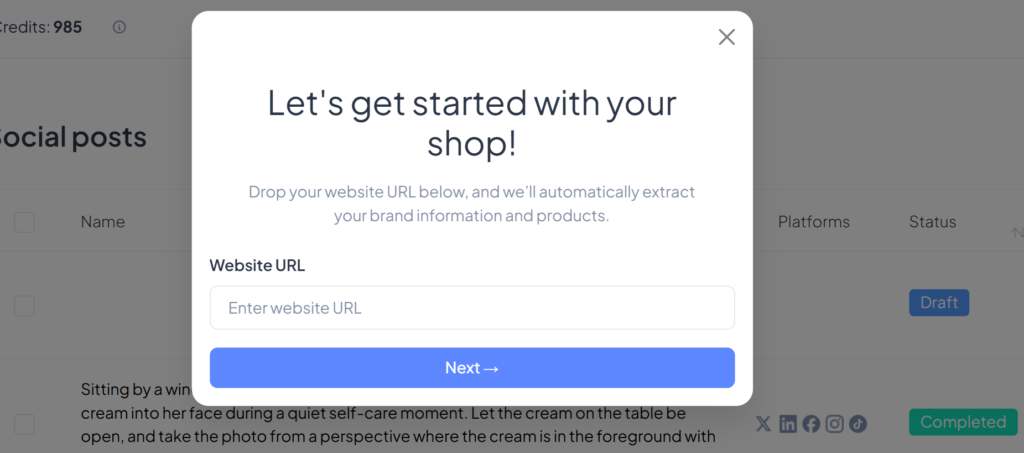 For example, with a few clicks, a founder generates ten posts based on selected products.
Captions, visuals, and formats are created automatically, with adjustments made if needed. Publishing dates, times, and platforms are then selected. Once approved, the content is scheduled. Everything is ready before your coffee gets cold.
If one post is set to go live every three days, those ten posts cover roughly a month of activity. Each asset is already adjusted to platform specifications. No resizing, reformatting, or manual uploading is required later.
That is how automation in social media marketing for online stores works in practice. Structured upfront effort replaces daily repetition.
The same applies to campaigns.
Instead of generating individual posts, campaign mode can be selected. You choose products, set the time period, and define the number of posts. Within that framework, Stryng builds a coherent content sequence that unfolds over weeks.
Automation and Long-Term Brand Development
Short-term sales can be driven by discounts and paid reach. Long-term growth depends on recognition.
Automation makes that recognition possible through consistency. When posting is systematic, the brand appears regularly in stories, feeds, and ads. The store doesn’t looks like a business that appears only when it wants to sell: it looks established, present, and active.
The brand begins to occupy a predictable space in the customer’s attention. Those who encounter structured, recurring content are more likely to remember the brand and return without needing constant promotional incentives.
When Automation Becomes Infrastructure
Stryng’s role in automation of social media marketing for online stores is more than daily publishing.
- It stabilizes visibility. Content does not depend on available time or temporary motivation. Activity continues even during operational busy periods.
- It strengthens narrative continuity. Campaigns can be designed as sequences that guide customers from introduction to consideration to purchase.
- It compounds familiarity. Each interaction builds on previous ones instead of restarting from zero.
Without automation, maintaining this level of consistency requires constant manual effort.
Try Stryng and bring automation to your business.