
If you own or run an online store, content work is almost never the first task in the morning. The day begins with orders, questions, small fixes, and things that cannot wait. By the time those settle enough to think clearly, several hours have already passed.
Content marketing for online stores is usually planned with good intentions. A few posts per week sound reasonable. The work looks small when it is written down. In practice, it competes with everything else that already claims time during the day.
By the end of the week, store owners have spent hours on content without ever feeling that they truly worked on it or that anything is properly done.
Tools like Stryng exist because this pattern repeats for thousands of store owners. It was built around the idea that content should adapt to the workday of an online store, not the other way around.
The First Interruption: “I’ll Just Do One Post”
Content work starts with a simple thought. There has been no post today. Something should probably go out.
A store owner opens the admin panel to check sales and ends up opening a social media instead. The intention is small: one post, ten minutes.
Then the questions begin.
Which product makes sense today. Has this item been shown recently. Does this image still look current. Should the caption be practical or lighter in tone.
Every question requires context. The owner checks past posts, scrolls through photos and reads old captions. Ten minutes becomes thirty, or more.
Content marketing sometimes fails at the writing stage. But the bigger problem is the thinking stage, where every post restarts the same internal conversation. This shows up most clearly in social media for online stores: small posting decisions repeat day after day.
Research on decision fatigue shows that repeated low-impact choices reduce speed and accuracy over time. This means that “just one post” costs much more than expected.
The Tool Maze That Forms Around One Post
Very few store owners use one tool for content.
A typical setup might include:
- the webshop for product details
- a folder with images
- a notes app for captions
- a design tool for edits
- a scheduling platform for publishing
Each tool works well on its own. Together, they they slow the work down.
A caption is drafted in one place, an image is adjusted in another. Both need to be uploaded elsewhere. A small mistake sends the owner back to the beginning of the chain.
Psychology behind task switching suggests that even brief changes of context increase completion time. This is common in ecommerce content marketing, where work is divided between many small tools and platforms.
A person selling handmade bags might open five different windows to prepare one post. None of them are difficult. The movement between them is what consumes time.
Stryng reduces this maze by placing creation, editing, scheduling, and publishing inside one system that starts from the store itself. The owner works in one environment instead of rebuilding the same chain every time.
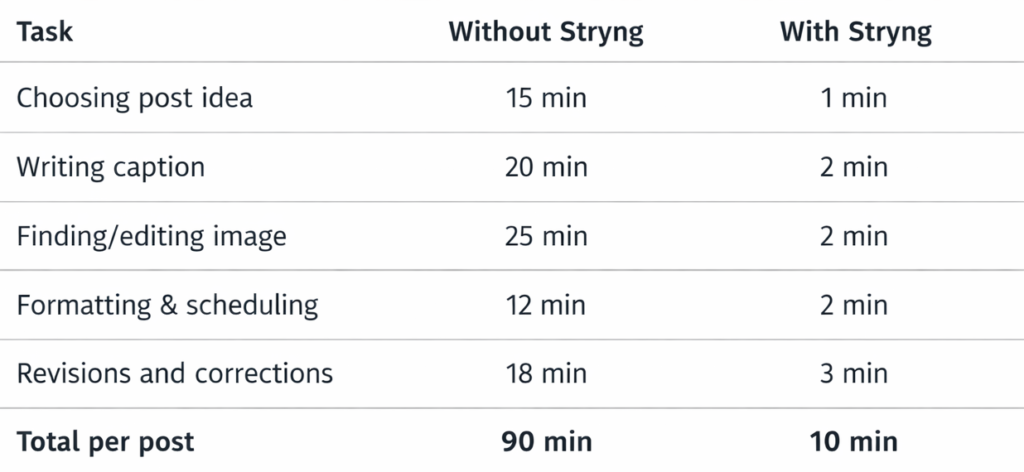 The Rework Loop in Content Marketing for Online Stores
Very little content goes out exactly as first prepared.
A caption sounds right in the morning and wrong in the afternoon. An image looks fine until it appears on a phone screen. A post scheduled for Friday no longer fits after a customer issue appears on Thursday.
Small edits lead to repeated visits, reopened files, revised drafts, and shifted schedules. None of this is dramatic, but it slowly stretches the work far beyond what was planned. Content marketing becomes a loop of preparation, doubt, adjustment, and rechecking.
You might rewrite the same product caption three times over two weeks, each time believing it will be final. Each return costs another slice of time.
With Stryng, edits happen inside the same flow where content is created. Feedback leads to immediate refinement. There is no need to reopen several systems to correct one detail.
Scheduling Becomes Its Own Project
Publishing is treated as the last step. In reality, it becomes a separate task.
A post may be ready, but it still needs proper timing, platform-specific formatting, and final confirmation before it goes out. Sometimes it requires manual posting.
On busy days, this process is easily interrupted. The owner plans to schedule it after lunch, lunch turns into customer support, and the post waits. The next day often looks the same.
Gradually, scheduling becomes fragile. Content exists but does not appear.
This is one of the main reasons content marketing for online stores slowly breaks down. The work is done, but the output is delayed.
Automation stabilizes this stage: once content is approved, scheduling and publishing follow automatically. The owner does not need to remember when or where something should go live.
How Store Data Removes Half the Work
Many content systems begin with prompts and ideas. They ask the owner to describe products, tone, and positioning (online stores already contain this information).
- Product pages explain value.
- Descriptions show priorities.
- Images reveal style.
- Navigation reflects structure.
Stryng uses the webshop as input. A store link and optional brand details form the base. From there, captions, visuals, and formats are generated in line with existing material.
Owner does not need to restate what the business already shows.
A furniture store with detailed specifications and lifestyle photos benefits immediately. The system reads that material and prepares content that reflects it, instead of asking for new explanations.
 Time Returns in Usable Form
When content stops pulling online store owners back into it again and again, they regain hours in usable form. Not fragmented minutes, but real blocks that support planning, customer care, and product development.
Stryng handles the repetitive mechanics of content production. The store owner stays involved, but without rebuilding the workflow each week.
Over time, content becomes reliable. Posts appear, campaigns run, and visibility stays steady.
In content marketing, that reliability is the real shift. It turns content from a drain on the day into part of the system that holds the business together.
Try Stryng and free your time.