
Not so long ago, webshops treated social media as a side task. A product launch needed a handful of photos, a caption, maybe a short ad campaign. Many brands posted three times per week and called it enough.
Now the same product can turn into a carousel, a short video, a vertical ad, a story sequence, a lifestyle image, a product comparison, a meme, a behind-the-scenes clip, and three caption variations for different platforms. The pace changed faster than most ecommerce brands expected.
That explains the rise of the AI social media post generators. Store owners wanted relief from the constant pressure to produce content. AI tools arrived at the right moment. Many could write captions in seconds, some could generate images. A few could even create videos.
The problem is that captions were never the main issue.
Social Media Turned Every Product Into Content
Social platforms changed the way products exist online.
People no longer discover products mainly through product pages. Social feeds now shape how potential customers encounter brands, compare products, and decide what deserves a closer look.
For ecommerce brands, this produced a new situation. A store selling candles, protein powder, sneakers, or kitchen tools suddenly operates inside a media environment. Products don’t exist as static items inside a catalog: they move through endless streams of images and short-form content.
The volume alone can become difficult to grasp.
Platforms also reward frequent publishing and fresh creative material. A campaign that looked polished two weeks ago may already look exhausted.
Research around creative fatigue found that repeated exposure significantly reduces engagement and conversion likelihood over time. They also suggest that many creatives now lose effectiveness within a few weeks, forcing brands to refresh assets continuously.
Large companies answer this pressure with bigger budgets. Smaller ecommerce brands usually improvise.
- A founder uploads product shots at midnight.
- A freelancer edits videos for a few weeks, then disappears.
- Someone experiments with Canva templates.
- Captions pile up inside Google Docs.
None of this came from a conscious decision to become a publisher. Social platforms pushed brands into that position gradually.
Why an AI Social Media Post Generator Loses Its Appeal So Quickly
The first interaction with an AI tool creates excitement. A few prompts produce captions in seconds. Product descriptions turn into Instagram copy almost instantly. For a brief moment, the problem appears solved.
Then the same issue returns in another form.
The caption exists, but the carousel does not. The product photo looks usable, though the video campaign remains unfinished. Someone still decides what gets published on Monday, what belongs on TikTok, and what should become paid advertising.
Ecommerce brands lose enthusiasm after the first wave of excitement because most of the AI content tools solve isolated tasks.
A brand launching a new product does not need one caption. It needs a sequence of creative material capable of surviving several platforms and several weeks of exposure. One product can generate educational content, reviews, promotional ads, seasonal variations, tutorial clips, comparison posts, and retargeting creatives.
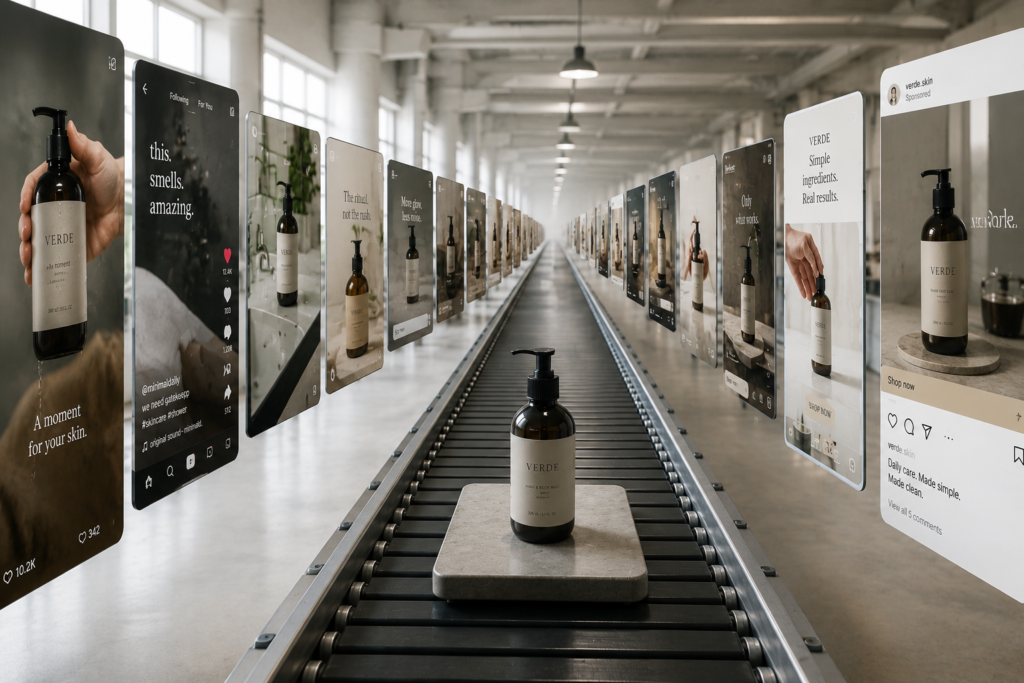 The workload doesn’t come from writing sentences: it comes from sustaining momentum around products moving through crowded feeds at high speed.
One Product Now Needs Ten Versions
- A product photo used on Instagram can look awkward on TikTok.
- A polished ad may appear too formal for short-form video.
- A carousel built for mobile viewing sometimes collapses inside another platform entirely.
Very quickly, the amount of required material multiplies.
One item inside a webshop branches into many visual directions. Even simple campaigns produce long chains of assets.
Most ecommerce brands built stores, sourced products, handled shipping, negotiated suppliers, and learned paid advertising. Few expected creative production to become continuous.
Social media now consumes large amounts of operational energy inside ecommerce companies.
Content Burns Out Faster Than Products
Products survive longer than the content promoting them.
A good jacket may stay inside a store for two years. The creative campaign surrounding that jacket looks tired after ten days.
Fashion brands experience this constantly. The same hoodie appears in multiple edits, backgrounds, formats, hooks, and visual styles during a single season. Beauty brands recycle ingredients into tutorials, close-ups, testimonials, routines, and trend-based clips. Home decor stores transform one chair into entire moodboards.
The visual environment simply became more hungry.
Ecommerce Brands Started Operating Like Media Companies
There was a period when social media functioned as promotion. A brand launched a campaign, posted updates, and directed people toward the store.
Now the relationship looks reversed: the content ecosystem itself shapes visibility.
Presentation cycles move too fast. Platforms reward frequency, variation, and adaptation to different formats.
Audiences also became highly trained consumers of visual content. People scroll through hundreds of creative decisions every day. Generic product shots disappear immediately into the stream.
This explains why ecommerce marketing borrowed habits from publishing companies and entertainment platforms. Brands experiment with narrative, recurring visual language, humor, personality, and serialized content because static promotion loses energy quickly inside modern feeds.
Ironically, AI accelerated this cycle.
What Smarter AI Social Media Tools Are Starting to Do
A newer category of AI tools moves beyond isolated content generation.
Instead of asking users to create every post manually, these systems analyze products, branding, visual direction, and store data in order to produce larger streams of creative material. The goal is ongoing output that maintains a coherent identity over time.
Some brands already experiment with tools like this. Stryng, for example, turns a webshop into social content by analyzing products and generating visuals, videos, ads, and scheduled posts around them. The interesting part is not the AI caption itself, but the reduction of scattered creative work normally divided between designers, freelancers, editors, and social media managers.
 That’s how the next generation of AI tools will function: more as creative infrastructure than writing assistants.
A Different Kind of Marketing Tool
During the last few years, products stopped existing mainly as products and became raw material for social media. One item inside a webshop now generates weeks of visual production around itself, long after the original product photos were uploaded.
For store owners, that became the exhausting part. Not writing a sentence or choosing hashtags. The draining part comes later, when the same products require another round of images, another variation for paid ads, another batch of edits formatted for different platforms. By the time one campaign settles down, the next one already waits in line.
That is why many discussions around the AI social media post generators feel narrow. Most online stores do not suffer from a lack of captions. They struggle with the endless operational drag surrounding content production itself
Some newer AI tools seem far more aware of that reality. They treat the webshop less like a source of product listings and more like a living archive of material that can continue evolving.
That is a very different idea from the old generation of AI writing tools, and probably a far more useful one for ecommerce.