
You want good products, clear photos and fair prices in your online store business.
Equally important, you want people to be able to find you. Today, that’s almost impossible without social media.
A post here, a story there, maybe a campaign during a sale. Before long, you realize that social media marketing without a team has become part of your daily reality, even if you never planned it that way.
At first, this feels manageable. You write captions at night. You take product photos on your phone. You post when you remember. Later, expectations grow. Platforms reward regularity, and your competitors seem to publish every day.
This is usually the moment when store owners begin to think about help. A designer. A freelancer. An agency. Someone who can “take care of social media.” The idea is reasonable, but the outcome is more complicated.
It’s one of the four core problems Stryng is designed to solve.
When “Getting Help” Becomes Another Job
Hiring support sounds easy. You find someone with good work. You agree on a price, send product photos and explain your brand. And wait.
Then coordination begins.
You answer questions, clarify details, revise captions, look for missing files and check schedules. You notice that one post uses last season’s product image, and send another message to fix it. None of this is dramatic, but it repeats and takes space in your head.
Sometimes a draft arrives at 9:47 p.m. with a filename like “final_v4_really_this_one.psd.” Sometimes “I’ll send it tonight” turns into next Tuesday, after two polite reminders and one carefully worded follow-up.
Many founders discover that working with freelancers or agencies creates a new role: part-time project manager. Even when the people involved are skilled and reliable, communication becomes part of daily work.
Stryng removes most of this exchange. You review what is generated, adjust what needs changes, and approve the result. The next version reflects it. The focus stays on the content.
The Cost of a “Small” Marketing Team
Money is part of every decision in a store.
A freelance designer may charge several hundred dollars per month. A social media manager costs more, and agencies usually start even higher.
Industry reports show that small ecommerce brands frequently spend a noticeable share of revenue on external marketing support.
There is also another cost that never appears on invoices: delay. Campaigns wait for revisions. Promotions wait for visuals. A seasonal offer launches with half the planned posts.
You may recognize situations like this:
- A post is ready, but the designer is away for a week.
- A video looks good, but the caption needs another round.
- An ad draft arrives after the sale has ended.
Nobody failed. Life happened. Still, your store pays the price.
Why Coordination Uses More Energy Than Creation
Writing captions and choosing photos are tasks that stay close to the product and the brand.
Coordination feels different.
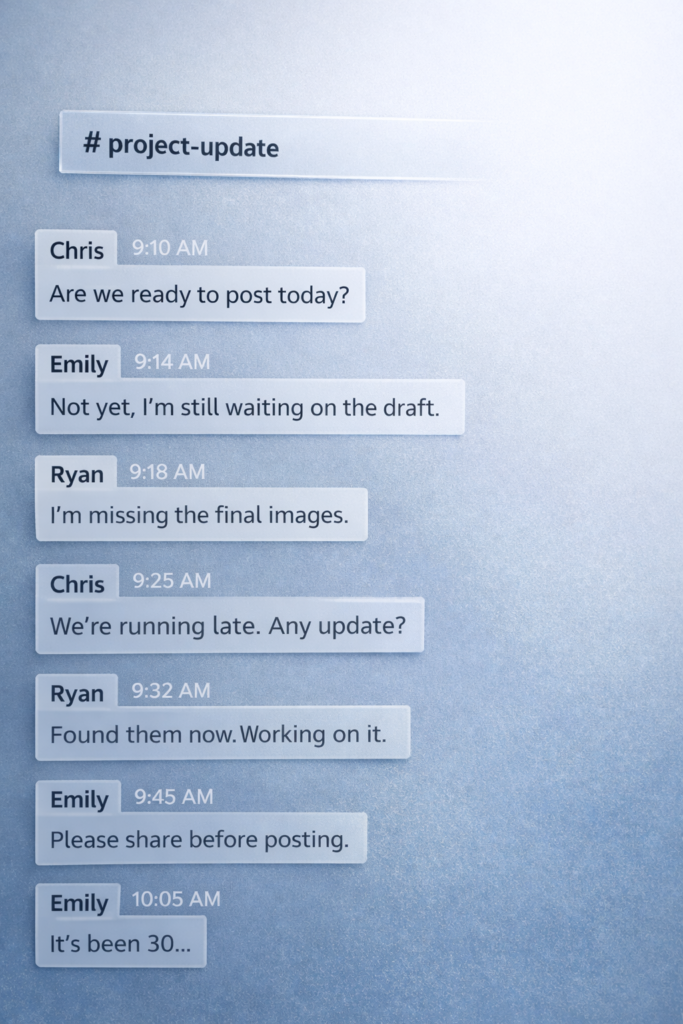 It means waiting for replies, choosing words carefully so nobody feels offended, and deciding whether to accept something that is “almost right” because another revision means another delay.
At times, this becomes oddly emotional. You hesitate to push too hard because someone is tired. You avoid giving honest feedback because you do not want tension. You accept mediocre work because you do not want another discussion.
A friend once joked that managing content felt like couples therapy for strangers. Everyone meant well. Nobody fully understood each other.
With Stryng, feedback remains practical. You change a prompt or adjust a setting, and the system responds. There is no personality to manage.
Social Media Marketing Without a Team, and Without Gaps
What Happens When Content Depends on Availability
People deserve rest. They need weekends. They take vacations. They get sick. Normal, human stuff.
For a business, this creates pauses.
Posting slows down. Calendars empty. Activity drops. Followers and platforms notice. Sometimes customers ask why nothing new has appeared for days.
Many brands move through a familiar cycle: strong start, steady phase, long pause, slow restart.
Each restart costs effort.
Regular posting supports content marketing for online stores more than occasional bursts. Simple, steady output usually performs better than rare perfection.
How Stryng Maintains Continuity
After connecting your webshop, Stryng studies your products and visuals.
- It generates photos, captions, carousels and short videos.
- It places them in a schedule.
- You review and approve.
- Publishing follows automatically.
There is no “back on Monday.”
There is no “sorry, I was offline.”
There is no message that begins with “I had a small emergency.”
For founders who rely on consistent output, this stability changes how marketing fits into operations.
 A Day in Two Different Systems
Consider two typical days.
Working With External Help
You open your inbox.
A designer asks for higher-resolution images. A manager asks about tone. An agency suggests changes to last week’s visuals.
You reply, search for files, upload images, explain context, and wait.
Later, one draft arrives: it needs edits. You write feedback and hope the revision comes before tomorrow.
Working With Stryng
You open Stryng.
New posts are ready: a product carousel, a short video, two captions.
One image looks too dark for your taste, so you adjust it and approve the rest.
The calendar updates.
You close the tab.
This difference is not about speed alone. It changes how much mental space content marketing for your online store occupies.
Choosing Stability Over Complexity
Some online store owners enjoy working with teams. But many don’t want to manage people, revisions, and schedules.
They want social media content that reflects their products without constant discussion. They want ecommerce marketing to support sales, not dominate schedules. They want systems that remain reliable as the business grows.
For them, social media marketing without a team doesn’t mean isolation: it means building processes that do not depend on coordination.
Stryng supports this approach. You provide your webshop link, refine the output and approve what matches your standards. The system handles creation, scheduling, and publishing.
Instead of managing people, calendars, and follow-ups, you manage outcomes.
Try Stryng for your store.