
Most online store owners don’t start their day thinking about marketing.
Orders, customer messages, stock checks, and small operational tasks come first. These activities shape the workday because they have direct consequences.
Content marketing sits nearby. It is important, yet rarely urgent. Posts can wait, and updates get delayed. Over time, this creates a gap between how a brand wants to appear online and what actually goes out.
Stryng was built for this reality. This tool does not try to turn store owners into marketers. It addresses practical problems that show up again and again in content marketing for online stores: time pressure, reliance on other people, uneven consistency, and repeated manual work.
What follows explains why this approach works.
1. Saving Time by Changing How Content Gets Made
Content marketing takes time when every post begins from scratch. Writing text, preparing visuals, adjusting formats, and publishing across platforms each require separate steps.
On their own, these steps seem manageable. Repeated throughout the week, they take over large parts of the day.
Time savings do not come from writing faster. They come from changing when and how content is created. Planned sessions remove repeated decisions and reduce context switching.
Stryng supports this shift by starting with the webshop itself. It functions as an AI social media post generator that works directly from the store. Products, descriptions, structure, and brand signals become the source material.
A store owner shares a webshop link and optional brand details. From there, content for platforms like Instagram, TikTok, Facebook, X, and LinkedIn takes shape.
Text and visuals are prepared together, posts are reviewed in batches, and approval happens once.
Publishing no longer depends on daily check-ins. Time is recovered through structure.
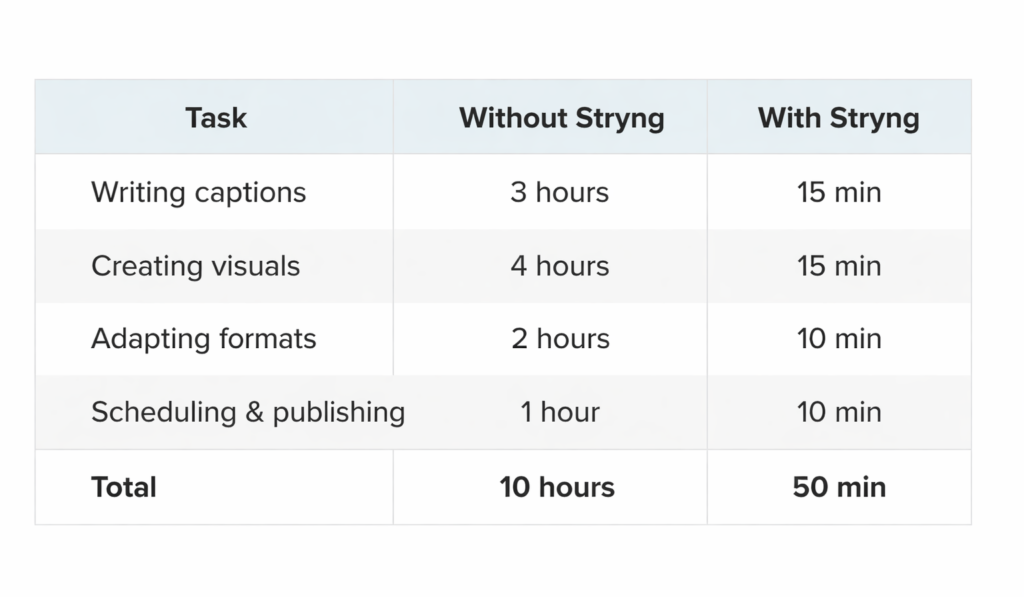
This table shows the average weekly time spent on social media content:
 2. No Team Needed to Maintain Quality
Many content workflows assume a team. One person writes, another designs, and someone else approves and publishes.
This setup works for larger brands, but many online stores operate under different conditions.
Saving Money Without Expanding Headcount
Founders often work alone or with a very small team. Hiring help introduces fixed costs before results are clear.
Freelancers charge per task or per month. Agencies require ongoing retainers and regular input. These expenses add up, especially when content needs to go out week after week.
Stryng changes this cost structure. Writing, visuals, and scheduling live in one system. Instead of paying separately for copy, design, and publishing, the store owner reviews content in one place. Output stays steady without adding recurring fees tied to headcount.
This keeps costs predictable. Spending stays connected to the tool itself rather than to the number of people involved.
Quality does not drop as activity increases, and growth does not require proportional increases in marketing spend.
Fewer Handovers, Fewer Dependencies
In content marketing for online stores, working with several people adds another layer of effort. Briefs need to be written. Feedback needs clarification. Revisions move back and forth.
Timelines stretch when small changes ripple through multiple roles.
Many founders prefer staying close to decisions instead of passing ideas to different contributors. They know the products, the customers, and the tone. Explaining this context repeatedly can take more effort than doing the work itself.
Stryng removes these handovers and reduces dependency on other people. The person who knows the store best reviews and adjusts output directly. There is no waiting for revisions to return and no coordination across time zones or schedules.
Work moves forward without delays caused by communication loops.
 3. Consistency in Content Marketing for Online Stores
Consistency rarely comes from discipline alone. It usually follows from structure. When content depends on memory or spare capacity, gaps appear.
Platforms tend to reward regular patterns over time. Long pauses reduce visibility, even when content quality remains high. This creates pressure to keep up, especially during busy periods.
Stryng supports consistency through a content calendar that shows what will be published and when, on all connected platforms. Once posts are approved, they remain scheduled.
For an online store preparing a sale, this means planning content before activity increases elsewhere. The campaign runs even when operations demand focus.
Consistency also applies to how a store speaks. When content is created piece by piece, tone often shifts. Product posts sound different from announcements. Updates vary depending on who wrote them and when.
Because Stryng generates content from the webshop and brand input, language stays aligned across platforms. Product descriptions, captions, and visuals follow the same logic. Over time, this creates a stable voice that customers recognize, even when posts appear on different channels.
4. Automation That Ensures Content Goes Out
Many content efforts slow down because too many steps depend on manual action. Products exist in the store, ideas exist in the founder’s head, but turning those into finished posts requires repeated setup.
Stryng automates the path from store data to published content. Products, descriptions, and brand input are turned into ready posts without rebuilding the process each time. Captions, visuals, formats, and timing follow a defined structure rather than manual assembly.
Once content is reviewed, scheduling and publishing proceed without additional steps. The same system handles preparation, adaptation, and execution.
This reduces the number of points where work can stall. Content moves forward as part of the system, not as a series of reminders.
 One Store, One System
Consider a solo founder running an online store that sells specialized home products. There is no team and no agency. Social media exists, but it often moves down the priority list.
At the start of the week, content for the next few days is ready for review. Product visuals, captions adapted to each platform, and one short video concept based on a popular item are prepared.
The founder spends less than an hour reviewing everything. One caption is adjusted, one image is replaced, and the rest stays as prepared.
After approval, posts are scheduled and published throughout the week while the rest of the workday keeps its usual rhythm. Orders are processed, emails are answered, and content no longer interrupts operations.
Instead of coordinating multiple people or switching between content creation tools, everything happens in one place.
You Dream It, Stryng Makes It Happen
Content marketing for online stores faces many challenges. Products change, orders move, customers respond, and seasons shape what is offered. The difficulty is turning that ongoing activity into published content without working more.
Stryng is built to handle that conversion. Time is saved by planning content ahead instead of creating it in fragments. Content no longer depends on a team, since writing, visuals, and publishing sit in one place. Regular output becomes reliable because it is planned, and automation carries posts through once they are approved.
The store continues its daily work, and content continues to appear where customers expect it.
Try Stryng and see how it works with your store.