
We all hope that as many people as possible will see our social media posts. In a way, we speak to everyone at once. We send our message out into those endless digital spaces with the expectation that people will hear it, and respond in some way.
That is true whether you are selling a product from your webshop or sharing your thoughts on the political situation or this year’s Oscars. You cast a net into the sea and wait.
That is a legitimate and simple tactic. But we know very well that the results are often similar to fishing: from time to time, you get lucky, while most of the time you are simply left waiting and nothing happens.
Yes, luck matters. But there are ways to encourage it a little and improve the chances of success.
To begin with, you need to take into account the fact that social media users are not an abstract audience, but groups of people with different habits and expectations.
Once that becomes more clear, the way your products appear on social platforms starts to look very different.
Social Media Users Are Not One Group
It is easy to think of your audience as a single category. You sell a product, describe its benefits, and assume that message will reach everyone in roughly the same way.
In reality, social media users form distinct clusters, and those clusters behave differently. Age and gender play a crucial role here.
This already suggests that your content does not land in a single environment. It travels through multiple ones at the same time.
How Age Shapes What People See and Engage With
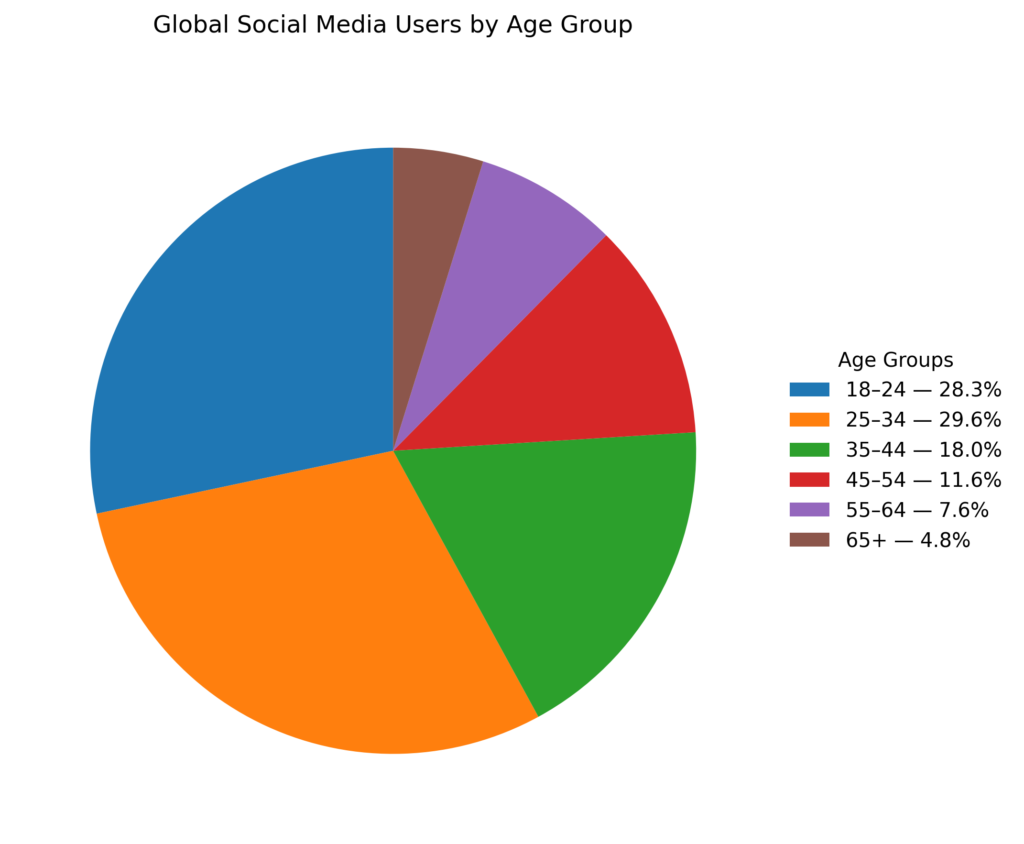
Reports like this one place the largest share of active users between the ages of 18 and 34, with usage gradually declining in older groups, although platforms like Facebook and YouTube maintain a strong presence well beyond that range.
 Younger Groups (18–24)
This group spends a large portion of its time on platforms built around short video.
TikTok, Instagram Reels, and YouTube Shorts dominate here.
- Visuals carry more weight than text.
- Content is consumed quickly: decisions about what to watch or skip happen within seconds.
- A product placed inside a real situation tends to perform better than a static image with a detailed description.
For example, a simple clip of someone using a skincare product during their morning routine will travel further in this group than a static image with a detailed description.
Early Adulthood (25–34)
This group forms one of the largest segments of social media users and plays a central role in ecommerce. It combines high activity on social platforms with a strong tendency to purchase.
Content still benefits from visual clarity, but there is more space for explanation. People in this group look beyond the first impression.
Reviews, demonstrations, and comparisons start to carry more influence.
A store selling fitness equipment might notice that short clips attract initial interest, while slightly longer demonstrations lead to actual clicks and purchases.
Mid-Age Groups (35–54)
Here, the platform mix shifts toward Facebook, YouTube, and in some cases Pinterest.
- Content becomes more direct.
- Practical value stands out more than style.
- People in this group tend to respond to clear explanations, visible benefits, and straightforward presentation.
A kitchen tool, for instance, performs better when shown solving a specific problem than when presented as a lifestyle item.
Older Groups (55+)
Usage remains strong, particularly on Facebook and YouTube, though the pace is different.
- Content that feels familiar and easy to follow perform better.
- Trust plays a larger role.
- Repetition and clarity help more than novelty.
How Gender Affects What People Respond To
Age explains part of the story: gender is another important factor. As you can see below, Statista’s data suggests that some platforms lean more toward male audiences, while others attract a stronger female user base.
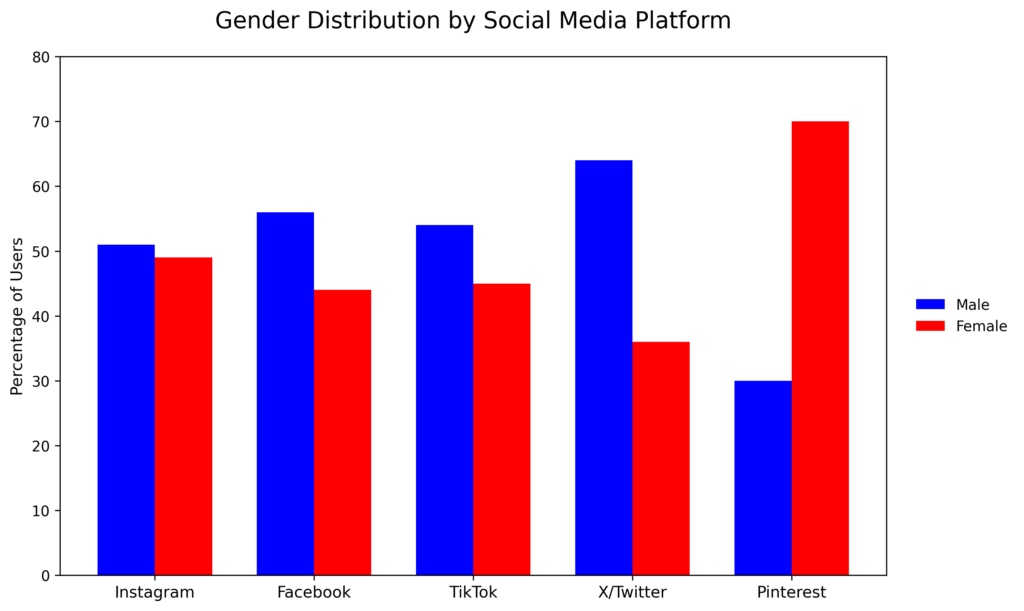 Additionally, within each age group, there are differences in how men and women respond to the same type of content.
In younger groups:
- Women tend to engage more with lifestyle-driven content, where products are placed within a broader context.
- Men show stronger response to content that highlights function or specific use.
Take a simple product like a backpack. One version of the content shows it as part of a day in the city, with attention to style and setting. Another version focuses on compartments, durability, and capacity. Both describe the same item, but they speak to different expectations.
In mid-age groups, these patterns continue in a more practical form.
- Women may respond more to content that connects a product to daily routine
- Men may prefer direct presentation of features and outcomes.
These are not rigid categories, but they are consistent enough to influence how content performs.
What This Means for Content for Online Stores
The same product does not exist as a single idea in the minds of social media users. It appears differently depending on who is looking at it.
You may present a product in one way, while a large portion of your potential audience would respond better to another.
For example, a watch can be shown as:
- a design piece within an outfit
- a tool with specific features
- a gift with emotional value
Each version connects with a different group. None of them is wrong, but none of them covers everyone.
This is where many stores begin to feel a limit. Creating one post is manageable. Consistent creation of multiple versions requires more time and coordination than most small teams can sustain.
When Content Starts Adapting to Different Social Media Users
Some stores move beyond this limitation by changing how content is created.
Instead of producing each post manually, they begin with what already exists inside the store itself. Product pages contain images, descriptions, and use cases that can be shaped into different formats.
A system like Stryng works from that starting point. You place your store link, and the system reads your products and brand elements. From there, it generates a range of outputs: visuals, short videos, carousels, and ads, each reflecting a different angle of the same product.
 You can review what is created, adjust details where needed, and approve. Publishing can follow without adding another step to your daily work.
The change becomes visible over time. Content begins to reflect the variety of your audience without requiring constant manual effort. Different groups of users start to see versions of your product that match their expectations more closely.
A More Complete View of Who Sees Your Store
Looking at social media users through age and gender shows that your audience is not a single entity, but a set of overlapping groups, each with its own way of interpreting what you present.
This does not mean you need to understand every detail about every group. It means recognizing that one version of your product will not reach all of them in the same way.
When you take this into account, the response changes. Engagement becomes less random, and signals become easier to read.
To create content that speaks to different users more effectively, start with Stryng.