
A company can post every day, send emails, run ads, and publish videos, but see very little in return. It may keep changing its content and adjusting campaigns, without getting any closer to the results it wants.
Before deciding what to publish or where to advertise, there are bigger choices to make. What does the business actually want to achieve? Which market makes sense? Who should it focus on? What can it realistically compete on?
That is why it is important to understand the difference between strategic marketing and marketing strategy. The terms are closely related, but they refer to different decisions.
Strategic Marketing vs. Marketing Strategy: What’s the Difference?
The easiest way to separate the two is to look at the question each one asks.
Strategic marketing: “What should we be trying to achieve in the market, and why?”
Marketing strategy: “What marketing plan will help us achieve it?”
Suppose an online store sells high-end coffee equipment. Its sales data reveals something unexpected: its most valuable customers are not casual coffee drinkers buying occasional accessories. They are serious home brewers who return for grinders, brewing equipment, filters, and premium beans.
That discovery can change the company’s priorities. The business may decide to focus on experienced coffee drinkers, position itself around expertise rather than low prices, and grow its recurring revenue through a broader product ecosystem.
Those are strategic marketing decisions.
The marketing strategy comes next. The company could create brewing guides, comparison videos, product demonstrations, email campaigns, search content, and paid social campaigns aimed at that audience. It can decide which channels receive resources, what campaigns to run, and which numbers will indicate progress.
A useful way to remember the distinction is this:
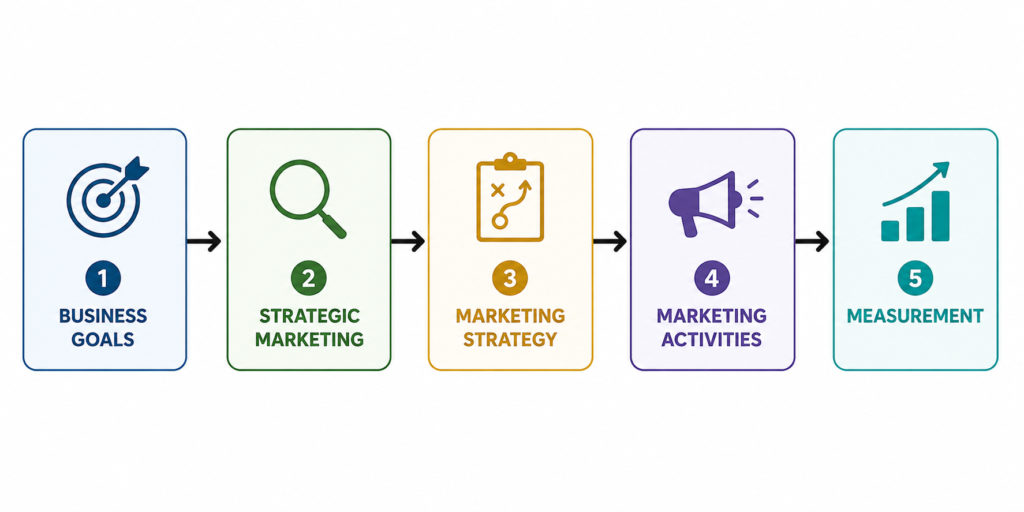
Strategic marketing determines the direction. Marketing strategy turns that direction into organized marketing activity.
The distinction becomes especially important when a business has limited resources. A large company can afford to test many channels and campaigns. A small ecommerce business usually cannot.
Strategic Marketing: Deciding What Deserves Marketing Resources
Strategic marketing happens before anyone starts arguing about Instagram versus TikTok, video versus blog posts, or paid ads versus organic traffic.
Those questions can be important, but they come later.
A Bigger Market Isn’t Always a Better Market
Businesses sometimes assume that growth means reaching more people. Strategic marketing challenges that assumption.
A small company selling professional cycling equipment could spend its budget trying to reach anyone who rides a bicycle. That audience is enormous, but much of it may have little interest in premium equipment.
A more focused opportunity might exist among serious amateur cyclists who already spend heavily on equipment and regularly replace components.
This is one of the reasons customer research is so important at the strategic level. The objective is not to collect interesting demographic facts, but to discover where the business has a credible opportunity.
Customer reviews, sales data, search behavior, interviews, competitor research, and conversations with customers can all reveal useful information.
Competition Is About More Than Other Companies
A company selling meal-planning software might initially see other meal-planning apps as its main competitors. After talking to customers, it may discover that the bigger alternative is much simpler: people keep using spreadsheets, bookmarks, notes on their phones, and recipes saved on social media.
That changes the competitive picture.
Instead of “How can we look better than another meal-planning app?” the company can ask, “Why would someone abandon the system they already use?”
That question can influence product development, positioning, messaging, and the type of marketing the company needs.
Strategic marketing therefore involves understanding the alternatives customers consider, including those that do not look like direct competitors.
Positioning Gives Marketing Something Specific to Communicate
A business cannot communicate everything about itself at once.
A small luggage company might sell lightweight suitcases, backpacks, travel organizers, and accessories. It could advertise dozens of product features. The harder strategic question is what idea should connect those products in the customer’s mind.
Perhaps the company wants to become known for luggage designed for frequent business travelers who need to move quickly through airports. That decision gives the marketing a stronger center.
Product demonstrations can focus on packing efficiency. Content can address short business trips. Ads can emphasize durability and organization. The website can reinforce the same positioning.
The marketing becomes easier to organize because the business has made a decision about what it wants to be known for.
Business Goals Set the Stakes
Marketing strategy can become disconnected from the business when marketing goals exist in isolation.
Suppose an ecommerce company has plenty of traffic but weak repeat purchases. Increasing traffic may look like a logical marketing goal, but it may not address the company’s biggest problem.
A strategic decision could place greater importance on retention and customer value. Marketing then has a different job. Email, post-purchase communication, product education, loyalty campaigns, and cross-selling may become more important than acquiring another wave of first-time visitors.
The strategic question is bigger than “How can we get more people to see our brand?” It is closer to: “What does the business need marketing to accomplish?”
Marketing Strategy: Turning Direction Into a Marketing Plan
Once the major decisions are clear, the business needs to decide what it will actually do.
Objectives Give Campaigns a Reason to Exist
A marketing strategy should give activity a measurable purpose.
“Grow our social media” is vague. “Generate more sales from existing customers” gives the marketing team a different set of priorities.
The objective influences the tactics.
A company trying to introduce an unfamiliar product may need educational content and demonstrations. A company with strong product awareness but weak conversion may need better offers, landing pages, customer proof, or retargeting.
The same channel can serve completely different purposes depending on the objective.
Channels Should Follow the Customer and the Objective
There is a persistent temptation to treat every social platform as something a brand needs to use.
A better marketing strategy asks where the intended audience actually spends time and what kind of communication the channel makes possible.
A company selling visually distinctive home decor may get substantial value from image-heavy platforms and short-form video. A B2B software company selling to operations directors may have stronger reasons to invest in LinkedIn, search, webinars, case studies, and email.
There is no “best” channel in general. The right choice depends on the audience and the goal.
Content Is Part of the Strategy, Not the Strategy Itself
A business can have a beautifully designed content calendar and still lack a coherent marketing strategy.
Imagine a fashion retailer publishing five social posts every week. Monday features a product photo, Wednesday has a short video, Friday contains a customer quote, and the following week brings another collection of posts.
The schedule is full. But what is the content supposed to accomplish?
If the business wants to increase sales in a new product category, the content should help that objective. Product demonstrations, styling ideas, comparisons, customer stories, and paid campaigns can each have a defined purpose.
For smaller ecommerce teams, producing all that material can become a significant operational task. AI systems such as Stryng can handle part of that execution by turning webshop information into product images, carousels, short videos, ads, and other social content. The business can review the material before publication. The tool produces marketing assets; the business decides what those assets should accomplish.
Measurement Changes the Next Decision
A marketing strategy should make it possible to learn from results.
A campaign that generates thousands of clicks but few purchases tells a different story than one that produces fewer visitors and substantially more sales.
The useful question is not always “Did the campaign perform well?” It is “What did we learn that should influence the next decision?”
That might mean changing the audience, message, landing page, creative format, budget allocation, or campaign objective.
 What Happens When the Two Are Disconnected
The difference between strategic marketing and marketing strategy becomes easiest to see when a business gets one right and neglects the other.
Plenty of Marketing, Little Direction
A business can publish constantly and still have weak marketing.
A restaurant delivery brand might spend months creating humorous social content because those posts receive strong engagement. Meanwhile, its actual growth opportunity could be increasing orders during weekday afternoons, when demand is low.
The content is active. The metrics may even look impressive. The activity simply isn’t connected to the commercial problem the business needs to solve.
This is what happens when marketing activity starts driving the direction instead of the other way around.
Good Strategic Thinking, Little Execution
The reverse problem can be just as damaging.
A founder may know exactly who the company should serve, understand its competitive position, and have a strong idea for how the brand should be perceived. Then nothing substantial happens because there is no practical marketing plan.
The business has direction but lacks a system for turning that direction into campaigns, content, distribution, and measurable activity.
A strategy needs somewhere to go.
Tactics Begin Making the Decisions
Disconnected marketing can also lead to a strange reversal: individual tactics start determining business priorities.
A social platform introduces a new format, so the company starts producing it. A competitor launches a campaign, so the company creates something similar. A particular post performs well, so the content team produces more posts like it.
A business can end up spending significant resources on activities that were never part of its original objective.
More Marketing Does Not Mean Better Marketing
Adding another channel does not automatically improve a marketing strategy.
A small ecommerce company with two people handling marketing may already struggle to produce useful content for its existing channels. Adding three more platforms can create a larger publishing schedule without creating additional business value.
Strategic thinking provides a basis for saying no. A clear direction makes it easier to reject attractive ideas that do not serve the current priority.
The same principle applies to campaigns. If every product, promotion, trend, and platform receives equal treatment, the marketing loses hierarchy. Customers see activity, but they don’t understand what the brand actually wants them to know or do.
Strategic marketing and marketing strategy are best understood as two connected levels of decision-making.
Together, they help businesses decide what to communicate, where to communicate it, what to create, what to measure, and what to leave out.