
The commute rarely begins when the door closes. It starts earlier, when unfinished work slips into mind.
Long before the road appears, part of the day is already spent.
For many online store owners, this feeling is familiar. It shows up in half-written captions, unpolished product pages, and plans for content marketing automation that never quite find time to take shape.
Distance and traffic play their role, but they are not the main source of the weight. What drains energy is the sense that work is already waiting and asking for care before the day has properly started.
The commute becomes less about movement and more about carrying lingering thoughts.
The Kind of Work That Follows You
Average daily commute times in many cities now pass 50 minutes round trip. That number alone looks heavy. Still, time tells only part of the story.
The deeper cost appears after arrival. Mental energy drops fast when people feel behind. Decision quality suffers and focus scatters.
A short drive can still drain the day when the work pile waits untouched.
Research on attention shows that unfinished tasks continue to occupy mental space. They draw energy even when no action is possible.
Studies of small businesses also point out how much time owners spend on content-related work, often broken into short sessions scattered across the day.
Commuting adds another weight to the day. Transport studies link longer commutes to lower reported well-being and higher fatigue. Combine that with unfinished content work, and the drain grows.
People find themselves thinking through wording while waiting at a light or replaying timing decisions while walking. The work follows along because it has nowhere else to settle.


Why Content Refuses to Stay in One Place
Content work has a shape that makes it hard to contain. It doesn’t always demand long hours, but it does ask to be returned to often.
For online store owners, this creates a situation where ideas live in notes, drafts remain unfinished, and publishing plans exist as intentions.
Because this kind of work depends more on judgment than on location, it slips easily into moments that were meant for something else. A caption can be rewritten in your head while sitting in traffic. A post idea can resurface during a walk. A question about timing can repeat itself without ever reaching a conclusion.
The commute becomes a place where work continues, even though nothing can actually be done.
This is often mistaken for a lack of discipline, but it is more accurately a matter of timing.
Content does not require a desk in the same way packing orders or answering messages does, but it does require preparation if it is going to stop looping in the mind. When preparation happens earlier, the pressure that usually attaches itself to arrival begins to ease.
When Preparation Happens Before the Day Begins
A subtle change happens when content work stops gathering around the start of the day.
There is no clear moment when everything feels different. Instead, it shows up through absence. Fewer reminders surface during the commute. Fewer mental notes repeat themselves. The sense of being behind loses some of its grip.
Content marketing automation plays a role here by taking care of the parts of the work that repeat. Text, visuals, calendars, and publishing can exist in a prepared state rather than waiting for the right moment. The system holds them steady so they no longer need to be carried in memory.
Imagine a small online shop that posts several times a week. Before, each morning began with the same question about what should go out that day. Writing and choosing images happened under time pressure, often after arrival.
After setting up a more structured content process, posts existed ahead of time. Visuals were ready, the calendar made sense, and publishing no longer depended on the first free hour of the day.
Nothing dramatic changed on the road itself, but the feeling at the start of the day is different.
What Changes When Fewer Things Wait for You
When pressure eases, messaging tends to become clearer. Tone feels more consistent and communication starts to sound more intentional. Over time, that steadiness supports trust, which plays an important role in how people respond to a brand.
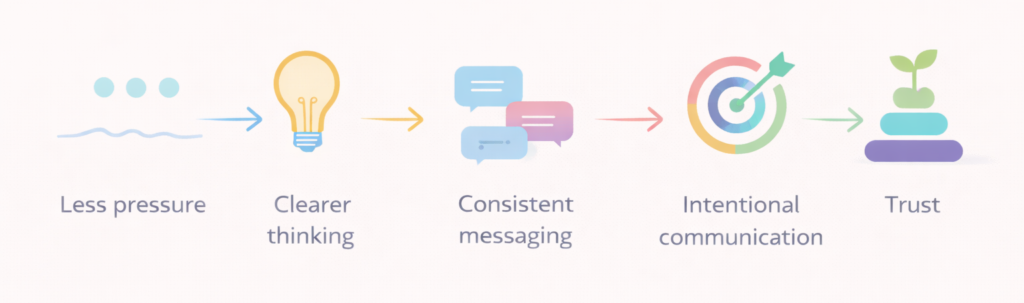

Concept of cognitive load helps explain this effect. When focus isn’t split across unresolved tasks, judgment improves. Fewer interruptions lead to more stable work.
Content marketing automation contributes by closing loops earlier in the process. Instead of carrying tasks forward, people encounter them shaped and ready.
Content Marketing Automation Changes How Time Feels
Automation is often described in terms of speed or scale, but those ideas miss something important. The deeper effect lies in how systems change the experience of time itself.
When a system prepares content ahead of schedule, work continues without constant prompting. People remain involved without needing to touch every step.
Content marketing automation tools work best in this background role. They shape copy and visuals, organize calendars, and handle publishing in a way that does not demand ongoing attention. Their presence becomes noticeable mainly through what stops happening.
There are fewer last-minute decisions, urgent interruptions or moments where something must be handled right away.
In this sense, they start to feel less like software and more like infrastructure.
The Commute Can Be a Boundary Again
The commute once served as a boundary between roles. It offered a pause between one part of the day and the next. Digital work blurred that boundary by allowing unfinished tasks to follow people everywhere.
When content preparation happens earlier, that boundary slowly returns. The commute regains its role as a transition rather than a warning.
It may not seem like much, but having less things pulling at your attention makes decisions easier. When decisions come more easily, the work tends to turn out better.


When Less Waits, More Becomes Possible
The commute will always exist. Roads stay crowded, schedules stay tight, and that part does not change.
What changes is what follows you there.
When posts, updates, and campaigns are already in motion, there is less to carry into the day: fewer decisions waiting, fewer loose ends pulling at attention.
Content marketing automation moves this work out of the margins and into a system, where repetition becomes routine and planning replaces urgency.
Tools like Stryng are built for that kind of work: present, consistent, and reliable. Try it.
The commute stops holding unfinished tasks and becomes what it was meant to be: a pause between places, not another place to work.