
Content creation for online stores looks simple on the surface. Add a product, write a caption, post a photo, go live.
In practice, it is a moving system: inventory shifts, promotions change, shipping timelines move. Owners answer customer chats and handle returns while trying to stay visible online.
The stores that perform consistently understand this early: content is not an expression of mood, it is infrastructure. Once it is built into operations, it stops competing with other tasks and starts operating alongside the business.
Creativity Doesn’t Wait for Free Time
Online Stores Publish Whether They Feel Ready or Not
A product arrives and the store needs a listing, images, and a narrative that places the item in a buyer’s life.
Delay costs visibility. Customers browse in brief intervals between tasks. A new product that appears with clean visuals and value proposition enters that window. One that waits does not.
Take a small skincare brand. A seasonal serum arrives on Tuesday. By Thursday, a simple product page is live: three clean images, a 40-word description, usage steps, and a short FAQ. On Friday, a carousel post shows texture, application, and outcome. None of it aims to impress. All of it is designed to function.
Content Is Part of Daily Operations, Not a Side Activity
The shift happens when content is treated like fulfillment or inventory checks. It becomes routine, not heroic. A short daily window after order processing captures what the store already has: a restock, a package, a customer note, a quick unboxing. That window feeds the week ahead.
Rituals remove the need to feel creative and replace it with forward motion. Inspiration follows execution more often than the other way around.
Why Ideas Stall Under Pressure
Too Many Small Decisions Slow Everything Down
Content fails less from lack of ideas and more from excess choice. Tone, format, visuals, timing, and calls to action pile up. Even strong ideas lose force when every step requires fresh judgment.
The correction is not more effort but fewer variables.
- Lock the voice
- Limit CTAs
- Choose a small set of visual treatments.
Once the field narrows, ideas move faster and execution sharpens. Cognitive load drops, and output rises.
When uncertainty appears, speed beats polish. Draft quickly, then edit in two passes: first for clarity, then for persuasion. This sequence produces reliable shipping without waiting for inspiration to arrive.
Writing, Visuals, and Posting Live in Different Places
Fragmentation breaks flow. Copy lives in notes, photos are stored across various devices, and scheduling tools further isolate assets.
Owners waste time retrieving what already exists. Energy drains before publishing even begins.
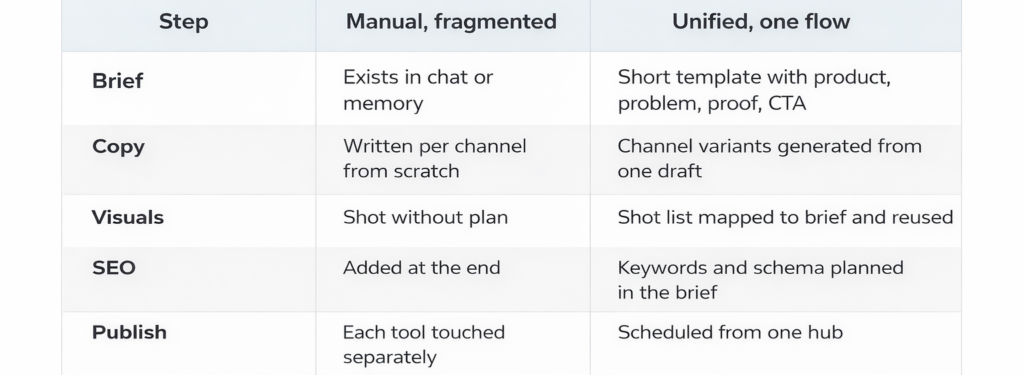
Unified systems correct this. Briefs, drafts, visuals, and final outputs sit together. Assets are tagged by product, campaign, and timing. One source feeds product pages, social posts, and emails without rework.
When everything orbits the same center, publishing becomes an extension of planning, not a separate task.
Deadlines Create Structure
Deadlines are often framed as pressure. In practice, a clear framework limits options and focuses effort. Structure does not constrain creativity: it directs it.
A simple cadence proves this:
- Two anchor days for store updates or collections
- Three lighter social touchpoints across the week
- Weekly themes to guide ideation
- One open slot for timely changes
This creates predictability without rigidity. Collaboration improves because expectations are visible. Decisions speed up because the course is defined.
Fewer Steps in Content Creation for Online Stores
Efficiency appears when content follows a single path. One brief informs copy, visuals, and distribution. Information is entered once and reused with intent.
A product brief can power a product detail page (PDP), a carousel, and a short video without duplication.
In this setup, repetition is intentional. SEO elements, image metadata, and accessibility are planned early. Publishing is not an afterthought, but the final step of a known sequence.
At this stage, content no longer depends on bursts of inspiration. It follows the system.
Compare:
When Content Creates Itself While You Run the Store
Many businesses now rely on AI assistance to manage content.
Structure and a single workflow keep words, visuals, and timing aligned. Deadlines stop feeling urgent because output is already in motion. Content creation for online stores becomes easier when it is designed to run as a system.
One example of this setup is Stryng. It generates visuals and text for online store social posts using a shared brief, suggests post ideas and themes when direction is needed, places content on a calendar, schedules it, and publishes directly to connected platforms.
A media library keeps assets organized so material stays available. Configuration is simple, and the system remains ready whenever the store needs to stay visible.
With Stryng, inspiration becomes available on demand. Try it and see for yourself.
Frequently Asked Questions
Q1: How often should an online store publish new content?
A weekly cadence for the store and several social touchpoints across the week works for most teams. A consistent rhythm beats sporadic bursts.
Q2: Where should a store start if it has no content calendar?
Start with two anchor days for core updates and add three lighter social slots. Themes like education or social proof keep planning simple and support a future content calendar.
Q3: Does ecommerce SEO matter for small catalogs?
Search matters for any catalog size. Clear titles, alt text, and product schema help search engines understand pages. A small store can still win with relevance.
Q4: What type of product photography converts best?
Show scale, texture, and context. A five-shot routine covers the basics and supports PDPs and social posts without heavy production.
Q5: Can AI replace a copywriter for a store?
AI can draft and format content, which covers most day-to-day needs. A human is still needed to set direction, approve claims, and make final calls. With systems like Stryng, that human presence becomes minimal.