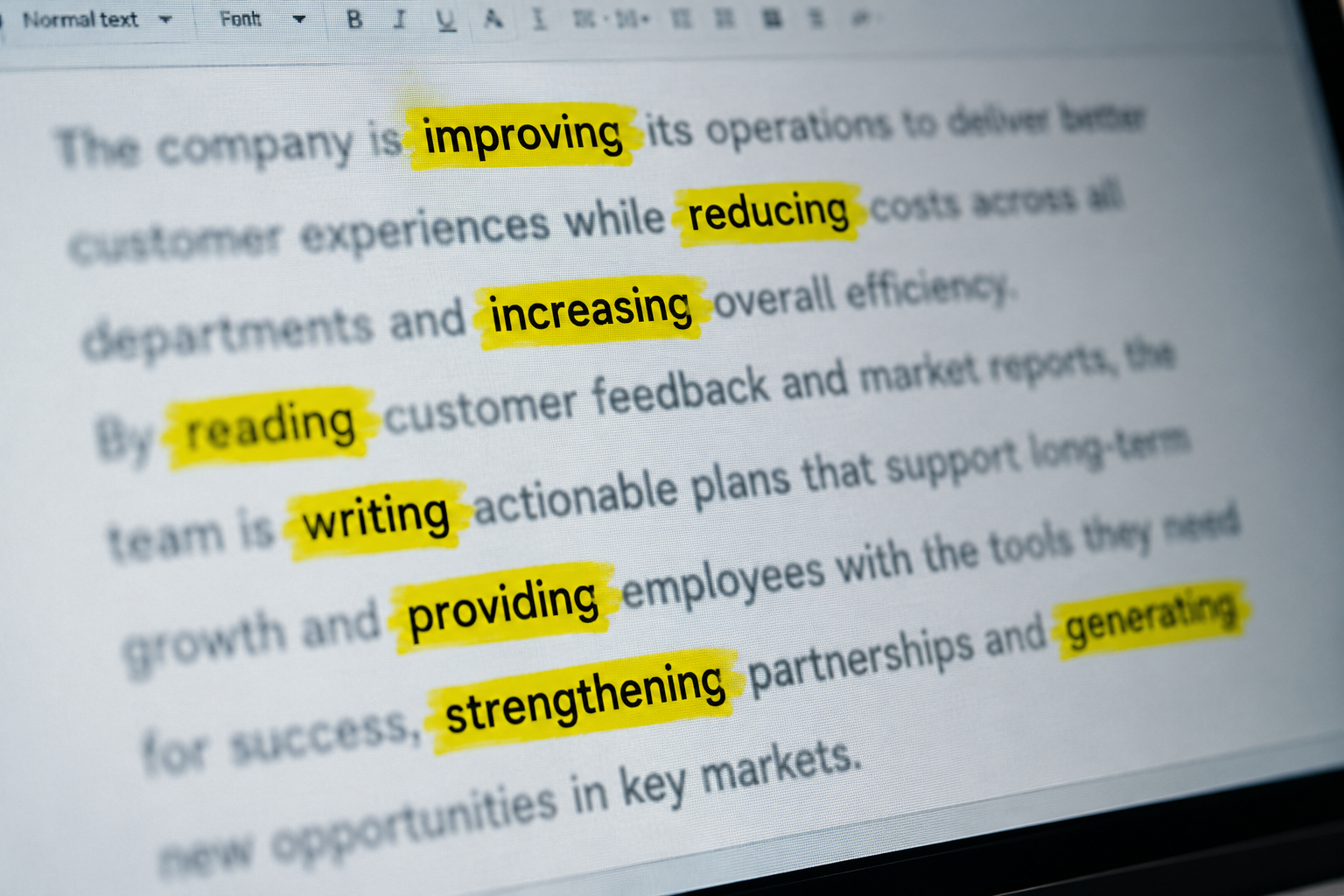
In our article on common sentence structures in AI writing, we identified the overuse of gerunds and present participles as one of the recurring patterns found in AI-generated text.
Here, we take a closer look at this pattern and show how to rewrite it.
First, a quick distinction. A present participle is the -ing form used as part of a verb or as an adjective:
- The company is expanding
- The growing company hired 50 new employees.
A gerund is also an -ing form, but it functions as a noun:
- Expanding into new markets requires careful planning.
- The company focuses on improving customer service.
Why does AI-generated writing rely on these forms so heavily? One reason is that they give language models an easy way to connect several ideas within a single sentence. Instead of starting a new sentence, the model can attach another action or piece of information with an -ing phrase.
For example:
- The company expanded into new markets, increasing its customer base and strengthening its position.
The sentence is perfectly grammatical. The problem appears when the same construction becomes a recurring feature of an entire article.
The good news is that you don’t need to eliminate -ing constructions. You can simply vary the way ideas are expressed.
5 Ways to Reduce -ing Overuse in AI Writing
1. Separate Sentences
One simple solution is to split a sentence when an -ing phrase adds a substantial amount of information.
Before:
- The company launched a new product, attracting thousands of customers and generating significant media attention.
After:
- The company launched a new product. Thousands of customers bought it, and the launch attracted significant media attention.
The second version gives the additional ideas their own subjects and verbs.
Another example:
Before:
- The researchers analyzed the results, identifying several unexpected patterns and raising new questions about the study.
After:
- The researchers analyzed the results. They identified several unexpected patterns and raised new questions about the study.
This approach works particularly well when the participial phrase contains more than two distinct ideas:
Before:
- The software analyzes customer behavior, identifying potential problems, recommending improvements, and helping businesses make better decisions.
After:
- The software analyzes customer behavior. It identifies potential problems and recommends improvements. This helps businesses make better decisions.
2. Use Subordinate Clauses
A subordinate clause is a group of words that contains a subject and a verb but cannot usually stand on its own as a complete sentence. It can be used to show how two ideas are related.
Instead of attaching a second idea with an -ing phrase, you can use words such as because, when, after, although, or while to make the relationship clearer.
Before:
- The company reduced its prices, attracting more customers.
After:
- Because the company reduced its prices, it attracted more customers.
Or:
- The company reduced its prices, which attracted more customers.
The choice depends on the relationship between the two ideas you want to make clear. You can show that one event happened before another, that one caused another, or that two things happened despite being in contrast with each other.
For example, when you want to make the timing between two events clear:
Before:
- The team changed its strategy, improving its results over the following months.
After:
- After the team changed its strategy, its results improved over the following months.
For contrast:
Before:
- The product received positive reviews, remaining unpopular with younger consumers.
After:
- Although the product received positive reviews, it remained unpopular with younger consumers.
3. Use Active Constructions
An active construction makes it clear who or what is performing the action. In English, this usually means putting the person or thing responsible for an action directly in the sentence as the subject, followed by a clear verb.
With -ing constructions, it can sometimes be less clear who is doing the second action. Turning that action into a direct clause, with its own subject and verb, can make the sentence clearer and more straightforward.
Before:
- The marketing team reviewed customer feedback, identifying several problems with the checkout process.
After:
- The marketing team reviewed customer feedback and identified several problems with the checkout process.
Here, the change is minimal: the participle becomes a regular verb.
Another example:
Before:
- The researchers examined thousands of responses, finding that most participants preferred the second option.
After:
- The researchers examined thousands of responses. They found that most participants preferred the second option.
You can also use an active construction to replace a vague phrase:
Before:
- The report provides several recommendations, helping organizations improve their internal processes.
After:
- The report recommends several ways for organizations to improve their internal processes.
The revised sentence puts the important action—recommends—at the center.
4. Use Prepositional Phrases
A prepositional phrase is a group of words that begins with a preposition such as by, through, with, under, or during. These phrases can sometimes express the same information as an -ing construction while giving the sentence a different structure.
Before:
- The company improved its customer service, reducing complaints by 30%.
After:
- The company improved its customer service, with complaints down by 30%.
Another example:
Before:
- The team completed the project, working under a very tight deadline.
After:
- The team completed the project under a very tight deadline.
Prepositional phrases can also help with gerund-heavy constructions.
Before:
- By improving communication between departments and increasing employee involvement, the company hopes to reduce delays.
After:
- Through better communication between departments and greater employee involvement, the company hopes to reduce delays.
The point isn’t to replace every -ing form with a prepositional phrase. It’s simply another option when you want to vary the structure of a sentence.
5. Use More Direct Wording
Sometimes you don’t need another grammatical construction at all. Cutting an unnecessary phrase can produce the strongest version.
Before:
- The tool provides users with several useful features, allowing them to manage their projects more efficiently.
After:
- The tool helps users manage their projects more efficiently.
The phrase allowing them to adds little.
Another example:
Before:
- The company simplified the application process, making it easier for customers to submit their information and reducing the time required to complete the form.
After:
- The company simplified the application process. Customers can now submit their information more easily and complete the form in less time.
Watch for expressions such as:
- allowing users to…
- helping businesses to…
- resulting in…
- leading to…
- making it possible to…
- providing an opportunity to…
These aren’t inherently bad. Sometimes they are simply unnecessary.
When editing AI-generated text, ask:
Can I say this more directly?
If the answer is yes, you may not need another construction at all.
When -ing Constructions Are Perfectly Natural
Present participles and gerunds are normal parts of English, and good human writing contains plenty of them:
- She sat by the window reading a book.
- Improving customer service takes time.
- The company is considering expanding into Asia.
None of these sentences needs to be rewritten simply because it contains an -ing form.
The more useful signal is the overall sentence pattern. Compare the examples above with a passage in which several consecutive sentences follow the same structure:
- The company launched a new service, attracting new customers and increasing revenue.
- It expanded its team, improving productivity and reducing delays.
- It opened new offices, reaching more clients and strengthening its position.
Each sentence is grammatical. Together, they create a noticeably similar rhythm and structure.
When editing AI-generated text, therefore, don’t treat every -ing word as a problem. Look at the sentence around it. If the construction is clear and natural, leave it alone. If it creates an awkward or repetitive pattern, try one of the alternatives above.
The goal is syntactic variety, not the elimination of -ing forms.