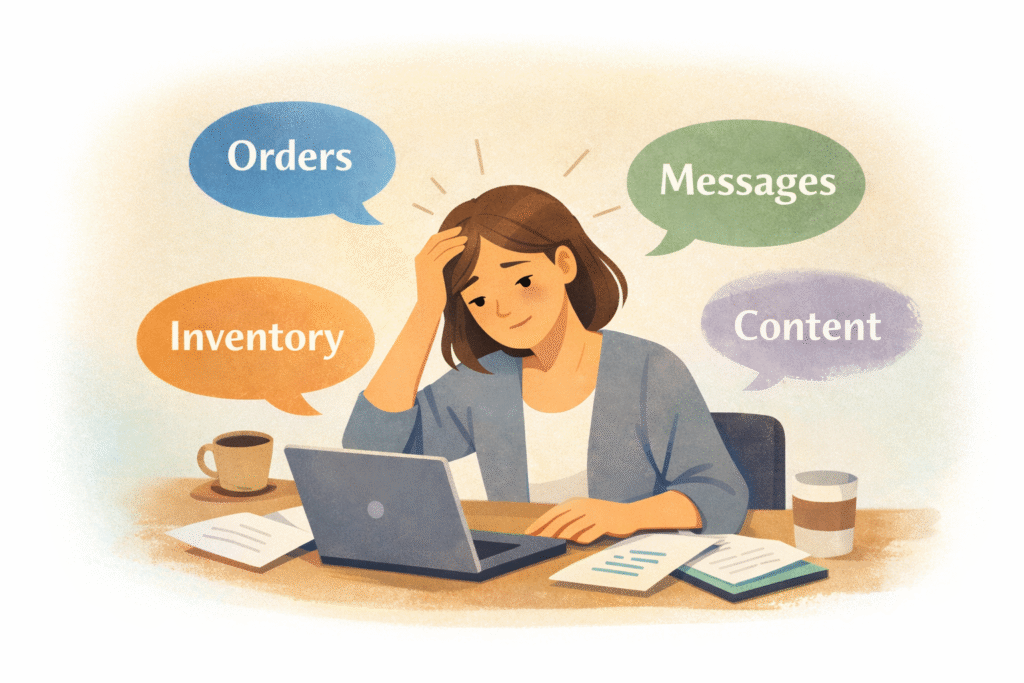
There is a particular kind of pressure that follows many people who run online shops.
Even on days when sales move and customers seem satisfied, there is a sense that something important remains undone. It’s there, not urgent enough to interrupt the day, yet persistent enough to return again and again.
Very often, that unfinished piece is the ongoing work of content marketing for online stores.
When everything competes for attention
Running an online store means holding many responsibilities at once. Decisions rarely arrive in neat order, and attention is pulled in several directions over the course of a single day.
Product details need review, customer messages need answers, numbers need checking, and small operational issues demand quick judgment.
Alongside all this sits the expectation to stay visible online, to communicate clearly, and to show some continuity in how the store presents itself. This is where content marketing begins to feel heavy.
Most store owners already understand why content matters. They have seen how regular posts help people recognize a brand, how clear explanations reduce uncertainty, and how familiarity supports trust.
Research suggests that consistent publishing supports long-term visibility and engagement. The idea itself is rarely in doubt. The difficulty appears when that idea meets the reality of a crowded workday.
Why content marketing for online stores feels heavier than it should
The gap usually does not come from a lack of intention. Many owners know exactly what they want to say. They notice recurring customer questions, common points of confusion, or moments worth highlighting. They collect ideas mentally, sometimes even writing them down.
The problem tends to appear later, when those ideas need to become actual text, images, and posts that go out on time. By then, energy has often been spent elsewhere, and content quietly slides into tomorrow.
Over time, this creates a pattern. One week brings a burst of activity and several posts go live. The next week passes with little or nothing shared. Drafts begin to accumulate without being finished.
None of this signals a lack of care or discipline. It reflects how demanding it is to move repeatedly between different kinds of work, especially when creative tasks are squeezed in between operational ones.
The mental cost of switching between roles
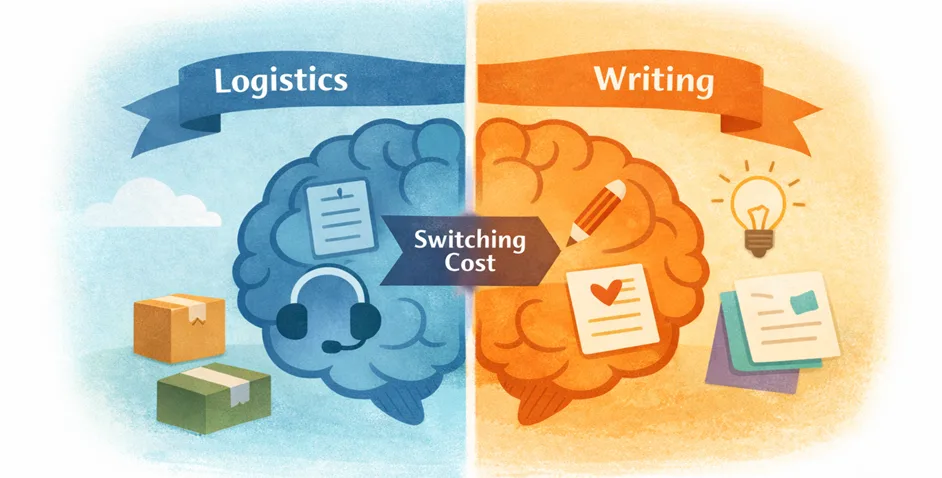
Frequent task switching carries a real cognitive load.
Writing or shaping messages requires a different mental state than handling logistics or responding to support requests. When those modes collide throughout the day, even small creative tasks start to feel demanding.
A short post may look simple, yet it asks for clarity of tone, awareness of audience, and consistency with everything that came before it.
Why content still earns its place
A well-written post can answer a question before it turns into a support request. A simple explanation can help someone feel confident enough to buy. A familiar style can make a store easier to recognize and remember.
Studies show that trust grows through repeated, coherent signals rather than isolated messages. That trust rarely arrives suddenly. It accumulates through exposure.
Content is important, but it asks for time that many store owners no longer have in reserve. Advice often stops at “be more consistent,” yet consistency itself depends on having a structure that supports it. Without that structure, motivation alone tends to fade.
Separating direction from execution
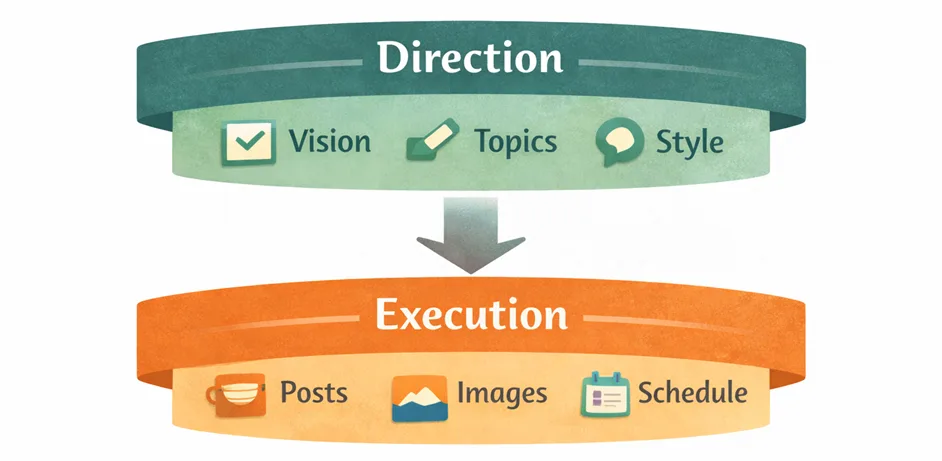
A more workable way to think about the problem starts by separating intention from execution. Most store owners already have a sense of how they want to sound and what kind of presence they want to maintain. The challenge lies in carrying that intention forward day after day.
Much of what makes up content marketing for online stores follows patterns once those intentions are clear.
Topics repeat in slightly different forms. Visual styles settle into recognizable shapes. Publishing rhythms stabilize. When these patterns are acknowledged, they can be handled without constant decision-making.
Structure and content marketing for online stores
This is where tools like Stryng come into play. Not as something that demands attention, but as something that supports continuity.
They take care of the repetitive work that turns direction into output. When the system understands what kind of content is needed, it can produce text, visuals, scheduling, and publishing without daily intervention.
A familiar situations
Consider a small online clothing store that release new items frequently. Writing fresh captions and preparing visuals for each release can interrupt other work. When content runs through a system, new products can be supported with consistent communication while the owner stays focused on inventory, planning, or customer experience.
What makes this approach effective is not speed or volume, but the way complexity recedes from view.
The work still happens, but it no longer competes for attention at every step. The process becomes more predictable, and predictability brings relief.
The content still reflects the shop’s way of speaking, but it no longer depends on finding spare moments late in the evening.
Stryng supports this kind of setup by maintaining continuity without demanding constant oversight, helping content stay aligned with the store’s direction over time.
When the work stops asking for attention
When one persistent obligation eases, something subtle changes. Owners notice they think more clearly about longer-term goals or spot opportunities they might have missed before.
Decisions feel less rushed. The absence of constant reminders to “post something” creates room for reflection, which leads to better judgment overall.
What changes once pressure eases
Content marketing works best when it feels like a natural extension of the business. When posts appear regularly with a steady tone, they begin to feel like part of the store’s infrastructure rather than an ongoing task.
Customers experience this as reliability. Owners experience it as relief.
This does not mean effort disappears: choices still shape results. What changes is the friction involved in carrying those choices forward.
The work becomes more predictable and easier to live with. In that sense, the value of a tool like Stryng lies less in what it produces and more in what it removes: the constant need to remember, to plan again, to start from an empty page.

A steadier way forward
Many people who run online stores are not short on ideas or care. They are short on uninterrupted space.
Content has a way of expanding to fill whatever time is left, which is why it so often ends up postponed. When that pressure eases, the relationship with content changes. It becomes supportive, not demanding.
In the end, content marketing for online stores does not have to feel like a second job running alongside the first. It can exist as a steady system that carries part of the load, allowing attention to return to decisions, direction, and growth.
When that happens, the work feels lighter because fewer things compete for focus at the same time.